


This immersive 4K drive begins at the edge of the Dunhuang oasis and heads straight into the immense open landscapes of Northwest China.
The journey starts on G215 near the Dunhuang Photovoltaic Industrial Park Viewpoint. One of the most striking sights in this area is Dunhuang’s 100 MW molten-salt solar thermal power station, where more than 12,000 heliostats surround a 260-meter receiver tower. Against the barren Gobi, this vast field of mirrors creates an extraordinary contrast between one of China’s oldest Silk Road landscapes and modern renewable-energy infrastructure.
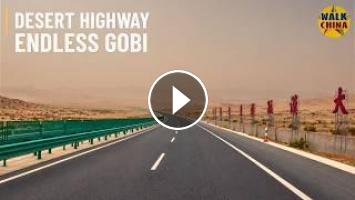
From here, the drive continues to Dunhuang West Toll Station and enters the G3011 Dunhuang–Dangjinshan Expressway. The oasis and cultivated land quickly fall behind as the scenery opens into gravel plains, barren ground, sparse desert vegetation and seemingly endless highway.
The Gobi around Dunhuang is not simply a sea of sand. Much of this landscape is stony desert, alluvial plain and wind-shaped arid terrain, with enormous horizons that make distance difficult to judge.
Dunhuang stands near the western end of the Hexi Corridor and was one of the great oasis crossroads of the ancient Silk Roads. For centuries, merchants, pilgrims and travelers depended on water, oasis settlements and mountain passes to move through this harsh region. Nearby lie the Mogao Caves, the singing dunes of Mingsha Mountain, Crescent Spring and the ancient Yangguan Pass — reminders of how closely desert geography and human history have always been connected here.
The full G3011 Dunhuang–Dangjinshan section extends 196.355 km and forms an important national highway link between the G30 and G6 corridors. Building it required engineering across saline soils, Gobi plains, strong winds, blowing sand and increasingly high, cold mountain terrain. Official project records note around 73 days a year with winds of Force 8 or higher in the wider corridor, with severe dust storms capable of reducing visibility to less than five meters.
Farther south, the road enters the vast landscapes of Aksai Kazakh Autonomous County, where desert and wasteland cover most of the territory. The region lies between the western Hexi Corridor and the northern edge of the Tibetan Plateau, surrounded by ranges including the Altun Mountains, Danghenan Mountains and Seshiteng Mountains. Aksai also brings a distinct Kazakh cultural layer to this remote corner of Gansu.
This drive ends at Dangjinshan North Toll Station. By this point the elevation has risen significantly and the seemingly level Gobi begins to give way to the mountain gateway ahead. Beyond here, G3011 continues toward the much higher and harsher crossing of Dangjinshan.
During this recording, cloudy skies gradually turned dusty. The distant mountains slowly faded into a grey-yellow haze, giving the final part of the drive an even stronger sense of isolation and scale.
No narration and no music — only the natural sound of the road, the car and the desert. Headphones recommended.
????️ Route Information
???? Start: Near the Dunhuang Photovoltaic Industrial Park Viewpoint on G215
???? End: Dangjinshan North Toll Station, G3011
????️ Road: G215 → G3011 Dunhuang–Dangjinshan Expressway
???? Distance: 102 km
???? Driving Time: 1 hr 20 min
⛰️ Elevation: 1,234–2,512 m
???? Date Recorded: August 26
????️ Weather: Cloudy → Dusty
#Dunhuang #GobiDesert #ChinaTravel #G3011 #4KDrive #ScenicDrive
The journey starts on G215 near the Dunhuang Photovoltaic Industrial Park Viewpoint. One of the most striking sights in this area is Dunhuang’s 100 MW molten-salt solar thermal power station, where more than 12,000 heliostats surround a 260-meter receiver tower. Against the barren Gobi, this vast field of mirrors creates an extraordinary contrast between one of China’s oldest Silk Road landscapes and modern renewable-energy infrastructure.
From here, the drive continues to Dunhuang West Toll Station and enters the G3011 Dunhuang–Dangjinshan Expressway. The oasis and cultivated land quickly fall behind as the scenery opens into gravel plains, barren ground, sparse desert vegetation and seemingly endless highway.
The Gobi around Dunhuang is not simply a sea of sand. Much of this landscape is stony desert, alluvial plain and wind-shaped arid terrain, with enormous horizons that make distance difficult to judge.
Dunhuang stands near the western end of the Hexi Corridor and was one of the great oasis crossroads of the ancient Silk Roads. For centuries, merchants, pilgrims and travelers depended on water, oasis settlements and mountain passes to move through this harsh region. Nearby lie the Mogao Caves, the singing dunes of Mingsha Mountain, Crescent Spring and the ancient Yangguan Pass — reminders of how closely desert geography and human history have always been connected here.
The full G3011 Dunhuang–Dangjinshan section extends 196.355 km and forms an important national highway link between the G30 and G6 corridors. Building it required engineering across saline soils, Gobi plains, strong winds, blowing sand and increasingly high, cold mountain terrain. Official project records note around 73 days a year with winds of Force 8 or higher in the wider corridor, with severe dust storms capable of reducing visibility to less than five meters.
Farther south, the road enters the vast landscapes of Aksai Kazakh Autonomous County, where desert and wasteland cover most of the territory. The region lies between the western Hexi Corridor and the northern edge of the Tibetan Plateau, surrounded by ranges including the Altun Mountains, Danghenan Mountains and Seshiteng Mountains. Aksai also brings a distinct Kazakh cultural layer to this remote corner of Gansu.
This drive ends at Dangjinshan North Toll Station. By this point the elevation has risen significantly and the seemingly level Gobi begins to give way to the mountain gateway ahead. Beyond here, G3011 continues toward the much higher and harsher crossing of Dangjinshan.
During this recording, cloudy skies gradually turned dusty. The distant mountains slowly faded into a grey-yellow haze, giving the final part of the drive an even stronger sense of isolation and scale.
No narration and no music — only the natural sound of the road, the car and the desert. Headphones recommended.
????️ Route Information
???? Start: Near the Dunhuang Photovoltaic Industrial Park Viewpoint on G215
???? End: Dangjinshan North Toll Station, G3011
????️ Road: G215 → G3011 Dunhuang–Dangjinshan Expressway
???? Distance: 102 km
???? Driving Time: 1 hr 20 min
⛰️ Elevation: 1,234–2,512 m
???? Date Recorded: August 26
????️ Weather: Cloudy → Dusty
#Dunhuang #GobiDesert #ChinaTravel #G3011 #4KDrive #ScenicDrive
- Категория
- Аксай

Комментариев нет.
Следующее
-
00:22

Driving Down the Almaty Mountains ????????️ #shorts
-
CHINA: Cities That Don’t Seem Real (Documentary)
-
15:50
India vs China 1962: Aksai Chin, Betrayal & War | Untold History
-
00:09
Charged up, I'm driving around Almaty #skateboarding #jumpclub #streetskating #skate #skatecity
-
01:20
????Belt and Road Explorer | Confucius Institute in Almaty: How I see China in the new era
-
00:08
Driving in Almaty #Almaty #drivinginalmaty #Kazakhstan
-
00:50
In Garaganda, Kazakhstan, this local Chinese restaurant is even better than those in China. #bar
-
09:08
Russia’s Rail Lifeline Is Crumbling as China Bypasses Putin
-
04:41
China-Kazakhstan Earthquake: एक के बाद एक भूकंप के झटके! कजाकिस्तान और चीन में हिली धरती |
-
03:10
Жаркент-Мешіт | Музей ~ museum |china
-
00:56

Adorable Fennec Fox Snuggling Time Cozy Baby Moments PababaTV
-
00:57

Adorable Baby Seal Snuggling Time – Cozy Sleepy Moments | PababaTV #babyanimals #cuteshorts
-
00:57

Even Cuter! Sleepy Baby Fennec Fox Cozy Moments PababaTV #cuteshorts #cozymoments #babyanimals
-
00:52

Adorable Otter Snuggling Time – Cozy Sleepy Moments | PababaTV #babyanimals #cute #cuteshorts #funny
-
4:00:01

4 Hours of Soft Teddy Bear Lullabies | Sleep Music for Babies
-
06:38

Блогер Хан мен әйелінің видеосы қалай тарап кетті?
-
03:04

Жүсіп Ақшора & Дәурен Абиев – «Армандамын» / COVER SHOW СОҢҒЫ МАУСЫМ
-
03:48

Maksat Rahmet – «Мен – қазақпын» / COVER SHOW СОҢҒЫ МАУСЫМ
-
02:38

Bayansulu – «Байқа» / COVER SHOW СОҢҒЫ МАУСЫМ
-
16:31

«ҚЫЗДЫҢ ЖОЛЫ» телехикая. 45-бөлім
 Загрузка...
